

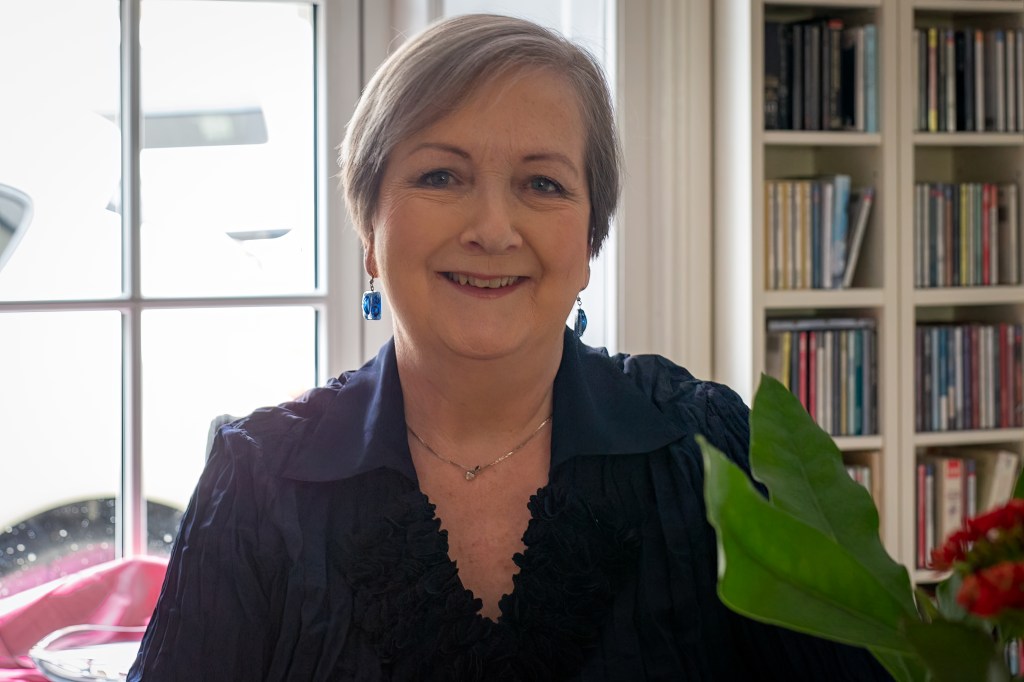
Photo by: Simon Robinson
Author of A Good Enough Mother
Catherine Dunne is the author of twelve published novels, several essays and one work of non-fiction. An Unconsidered People documents the lived experience of some half a million Irish immigrants to Britain in the dismal years of the 1950s.
Catherine’s novels have been shortlisted for a number of prizes, including Novel of the Year at the Irish Book Awards and the International Strega Prize.
The Things We Know Now won the Giovanni Boccaccio International Prize for Fiction in 2013, and The Years That Followed, published in 2016, was longlisted for the International Dublin Literary Award.
Her latest novel, A Good Enough Mother, won the European Rapallo Prize for fiction in November 2023.
Her work has been translated into several languages.
She was the recipient of the 2018 Irish PEN Award for Outstanding Contribution to Irish Literature and is a member of Aosdána.
Her newest book, A Good Enough Mother, was published on June 18th.
Praise for A Good Enough Mother
“Tender and harsh in equal measure, A Good Enough Mother – what an apt title – is an absorbing story of women over generations suffering through and somehow managing their various and variously intricate lives. And what a story it is – ‘epic’, one might say, except that women are too sensible to conceive of life as an epic venture. So, simply: a marvellous book.” — John Banville
“There is nothing that is ever made better by silence,’ says one of the characters in Catherine Dunne’s new, complex and multi-layered novel, which sets about revealing the secrets of several apparently unrelated characters across three time periods. It comes as no surprise to anyone who knows her work that Dunne writes with insight, empathy and skill in this exploration of the lives of women and girls in Ireland, past and present. She reveals patterns established by a misogynistic state and the ordinary families who comply – if not collude – with its diktats. But this novel is not at all bleak. Its strength lies in the tremendous bonds established between women who resist conventional definition and support each other through trauma and grief as they create new lives for themselves. Each separate strand of A Good Enough Mother is vivid and distinct until we approach the end, when those strands are deftly drawn together to reveal how interconnected the stories and characters are. In many ways their several experiences are emblematic of women’s lives more generally, not only in Ireland. It will come as no surprise to Catherine Dunne’s many loyal readers that the women they will meet in the pages of this enjoyable novel are strong, capable agents of positive change in their own lives and the lives of others. Crucially, theirs are stories of survival, love, friendship and hope.” — Lia Mills
“This is a nerve-jangling, urgent, brilliantly-paced novel. I read it quickly – I had to. I had to know what was going to happen, and I had to admire the craft and flair that went into its writing.” — Roddy Doyle
“This is a novel of interlinked tales: some of which hark back to historical stories known to us about female lives throughout the world, unique to each country depending on its history. You may become most hooked on one of them. I did: that of the horror created by the belligerence of one brother.” —Evelyn Conlon
“I kept thinking about this secret army of women. All of them – all of us – all over Ireland. Mothers of lost children’: A Good Enough Mother stitches together the public and the private to devastating effect. Intimate, tender, terrifying, intricately patterned, and told with Catherine Dunne’s characteristic empathy, this is an Irish novel for our times.” —Neil Hegarty
“Nobody writes like Catherine Dunne. She is wise, clever, and profoundly compassionate. This is a compelling story exploring and comparing the lives of Irish girls and women over the past seventy years. It’s deep, it’s moving, and it’s full of surprises.” —Eilis Ni Dhuibhne
“This book is a complex patchwork quilt of women’s voices telling the story of several girls – one as young as 14 – consigned by the church-state carceral complex to Mother and Baby Homes. It follows them through their subsequent lives embracing several generations, movingly demonstrating how the brutality of such institutions ramifies and amplifies through time. It is not, however, a story of suffering and no more; it is also an exploration of the redemptive power of love in all its expressions. In many ways this is a joyful book, revelling in the solidarity of sisterhood and crossing class and national divisions. Beautifully written and elegantly plotted, it weaves multiple stories and multiple voices in a way which is both intriguing and engaging. Socially engaged writing such as this can make an important contribution to how Ireland understands itself, its past and the legacy of the Mother and Baby Homes, while also providing hope for future generations. I’ve never understood why Catherine Dunne is more famous in Italy – where she is literally a household name – than in Ireland. I hope this wonderful book will help to remedy that situation.” —William Wall
“With characteristic deftness, courage and compassion, Catherine Dunne constructs an intricate patchwork of woven lives exploring motherhood – and its unspoken losses – in the shadow of sexual violence. Taut and reflective, this dark material leaves a lasting sensation of light, brilliance and hope.” —Mia Gallagher
“Catherine Dunne has established herself as the voice of the world of women, their suffering and emotions, and the injustices they endure and overcome with courage. With Una Buona Madre, translated by Ada Arduini, Catherine Dunne weaves together, like in a mysterious noir, ill-fated and diverse lives. Switching back and forth between the lives of all her characters links a compelling present to a troubled past, shedding light on the very different ways of being a mother, together with the historic past of a Catholic country such as Ireland.” —Eva Cantarella and Nadia Terranova, chairs for the Rapallo European Award
“It is a truly Irish novel in which the stories of women – Tess, Maeve, Eileen, Betty, Joanie – and their families unravel and intertwine within a timeframe that goes from the 1960s to the present at the time of the pandemic. Stories told in the first, second and third person from constantly changing points of view, with a coherent and compelling plot that never loses sight of anything despite the complexity of the constant shifts, even though sometimes the reader feels taken aback and must carefully put together the puzzle once again. Stories held together by a fine thread that keeps us hooked. It has been a long time since I couldn’t literally stop reading at night. Every story is permeated with great humanity and depth, dealing with difficult and strong existential themes and realities with lucidity and without ever falling into honeyed sentimentality.” —Laura Cimetta
 Betimes Books
You must be logged in to post a comment.